

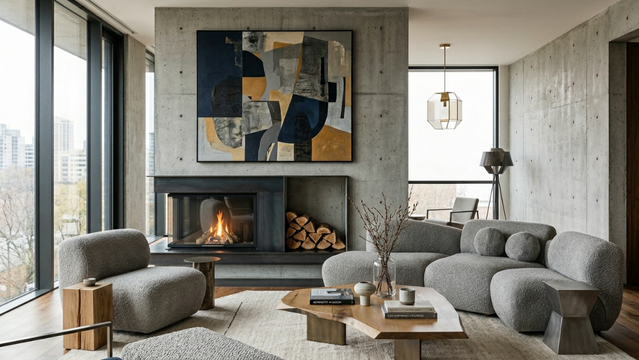
Across furniture, architecture, and wall art alike, Contemporary Design increasingly favors asymmetry over rigid formal balance, reflecting a broader cultural shift toward spaces that feel organic and lived-in rather than showroom-perfect. This preference extends naturally into how homeowners select and arrange artwork.
This shift away from strict symmetry mirrors changes in how people actually live within their homes. Rigid, perfectly mirrored arrangements often feel formal and somewhat impersonal, better suited to historical interiors than contemporary daily life. Asymmetrical design choices, by contrast, tend to feel more relaxed and adaptable, accommodating the genuine irregularity of how furniture and decor accumulate over time in a real, lived-in home.
Within wall art specifically, this preference shows up as a growing appetite for abstract paintings with deliberately unbalanced compositions, asymmetrical groupings of multiple smaller pieces, and gallery walls that embrace irregular spacing rather than rigid grid alignment. Each of these choices reflects the same underlying design philosophy: visual interest generated through calculated imbalance rather than predictable repetition.
Designers working within this contemporary framework often pair asymmetrical artwork with similarly asymmetrical furniture arrangements, reinforcing the room’s overall design language rather than introducing conflicting visual logic. Studios such as Artextured frequently supply the wall art component of this approach, offering abstract pieces specifically composed to hold visual interest within otherwise asymmetrically arranged spaces.
This design philosophy also extends to how art is hung relative to furniture. Rather than centering a painting precisely above a sofa or bed, contemporary asymmetrical styling sometimes intentionally offsets artwork slightly, creating a subtle visual tension that echoes the painting’s own internal composition.
As contemporary design continues moving away from formal symmetry toward organic, intentionally imbalanced arrangements, asymmetrical abstract art remains perfectly suited to this broader aesthetic direction.
This preference for asymmetry extends beyond individual rooms into how entire homes are increasingly planned, with open floor plans deliberately avoiding the rigid, room-by-room symmetry common in earlier architectural traditions, favoring instead a more fluid, asymmetrical relationship between connected living spaces.
Within this broader architectural context, asymmetrical artwork functions almost like a visual extension of the home’s underlying spatial logic, reinforcing rather than contradicting the irregular, organic flow that defines much contemporary residential design. Designers working on open-concept renovations frequently select asymmetrical abstract pieces specifically because they integrate naturally into transitional zones between rooms, where a rigidly symmetrical composition might feel disconnected from the surrounding architecture.
Technology has played an indirect role in this aesthetic shift as well, since digital tools allow architects and interior designers to visualize, test, and refine asymmetrical spatial arrangements far more easily than was possible with hand-drafted plans, lowering the practical barrier to pursuing genuinely irregular layouts that might previously have been too time-consuming to fully develop before committing to construction or renovation.
Craft traditions have also responded to this broader asymmetry trend, with hand-thrown ceramics, irregular woven textiles, and organically shaped furniture all gaining significant popularity alongside asymmetrical wall art as part of a unified cultural movement away from manufactured uniformity. Collectors building rooms around asymmetrical art often find that these craft objects make natural companions, reinforcing a consistent design language across multiple categories rather than leaving the artwork feeling stylistically isolated within an otherwise conventional surrounding interior.
Frequently Asked Questions
Why is asymmetry becoming more popular in contemporary interior design? It reflects a broader shift toward relaxed, lived-in spaces that feel organic rather than formally arranged, mirroring how people actually use their homes.
Should asymmetrical art be centered above furniture? Not necessarily; contemporary styling sometimes intentionally offsets artwork to create subtle visual tension that complements the room’s overall design.
Does asymmetrical design work well with traditional furniture? It can work as a contrast, though it generally integrates most smoothly with contemporary or eclectic furniture arrangements that already embrace some irregularity.
