

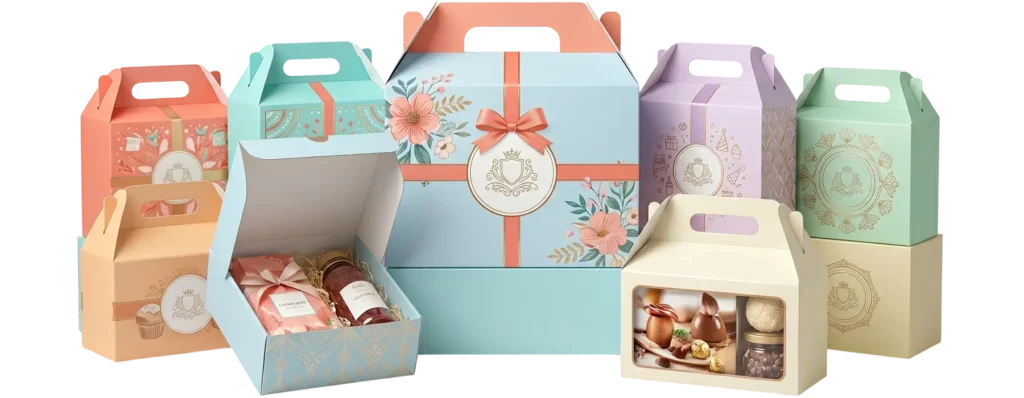
Ask anyone who runs a bakery or a small gift shop what box they reach for first, and there’s a decent chance it’s a gable box. You’ve probably carried one yourself without ever learning the name. Fold top, built in handle, that slightly nostalgic milk carton shape. It just works. Gable Packaging isn’t new, but it hasn’t gone anywhere either, and honestly, that’s a bit surprising in an industry obsessed with reinvention. Grand View Research pegged the global corrugated boxes market at USD 212.3 billion in 2025, and styles like this one keep grabbing a bigger slice of that pie because people still care about how a box feels in their hands. Teams at Boxo Packaging run into this preference constantly when clients ask for something that isn’t just another plain carton.
Why Do Brands Still Bother With Gable Packaging Instead of a Plain Box?
Because it does two jobs at once. Gable packaging works as the box and the bag, so there’s no extra tape, no separate handle, nothing bolted on afterward. A regular shipping box is fine at its job. It gets the product from point A to point B without much drama. But it rarely makes anyone smile when they open the door and see it sitting there. A gable box does more with less. It protects whatever’s inside and it doubles as something you’d actually want to carry down the street, maybe even show off a little.
That’s part of why bakeries, florists, and gift shops keep coming back to this shape, and it’s spreading into subscription boxes too. Persistence Market Research found food and beverage packaging made up around 33.1 percent of the corrugated packaging market in 2025, and a good chunk of that runs through gable style designs.
There’s a money angle too, not just an aesthetic one. Skip the extra bag, skip the extra ribbon, and the savings add up fast once you’re shipping thousands of units a month.
E-Commerce Basically Rewired Demand for Gable Packaging, Didn’t It?
Pretty much. Online shopping turned gable packaging from a bakery counter item into something gift brands and subscription boxes lean on constantly, mostly because of what happens the second a parcel lands on someone’s porch. Amazon, Alibaba, Flipkart, these platforms didn’t just grow, they trained shoppers to expect a small moment of theater when a package arrives. GM Insights has flagged this shift as one of the bigger drivers behind demand for customized, visually distinct packaging shapes.
And the scale here is genuinely hard to picture. US retail e-commerce sales hit roughly USD 879.54 billion across the first three quarters of 2025 alone, according to figures cited by Towards Packaging, with the full year trending toward USD 1.26 trillion. Every one of those orders needs a box, and plenty of brands would rather that box do some marketing work on the way.
Subscription boxes piled on top of that trend. Beauty kits, snack subscriptions, curated gift sets, they all lean toward fold top designs because the shape photographs well for that inevitable unboxing video. Boxo Packaging has watched smaller e-commerce sellers use this exact trick to look far more premium than their budget would suggest.
A few reasons brands keep circling back to this style:
• It removes the need for a separate paper bag or ribbon handle
• It photographs better for social content, which sounds shallow but genuinely drives sales
• It’s light, which keeps shipping costs from creeping up
• It works equally well on a retail counter and on a doorstep
What Actually Matters Before You Order Corrugated Gable Boxes?
The Corrugated Gable Boxes take that familiar fold top shape and back it with fluted board instead of thin paperboard, so they survive shipping in a way a flimsier version just can’t.
The fluted layer inside works like a cushion. It soaks up small bumps during transit, something a plain folding carton has no real answer for.
Single wall corrugated board is the workhorse behind most of these boxes, and there’s a reason for that. Persistence Market Research reports single wall boards held close to 39.6 percent of the global corrugated packaging market in 2025, mostly because they balance strength against weight better than anything else at that price point.
If you’re shipping soap, candles, small electronics, anything with a bit of heft, corrugated is the safer bet over a plain paperboard gable box that might buckle halfway through delivery.
Corrugated Gable Boxes and the Sustainability Question, Is It Real or Just Marketing?
It’s real, at least on the numbers. Corrugated Gable Boxes land near the top of the eco friendly list mainly because corrugated board recycles at a rate most materials can’t touch. Maximize Market Research puts the recovery rate for old corrugated containers above 90 percent globally, which is a genuinely strong number.
That figure matters more than it sounds. It means the box sitting on your desk right now has a real shot at becoming another box down the line, not landfill filler for the next fifty years.
Regulation is nudging things along too. Europe’s Single Use Plastics Directive has pushed brands away from plastic clamshells and toward paper based formats like corrugated packaging, a trend Towards Packaging has tracked closely.
So if a brand wants to cut its footprint without overhauling everything, swapping plastic packaging for corrugated is about as easy a win as this industry offers.
Can Corrugated Gable Boxes Actually Help With Branding, or Is That a Stretch?
They can, and it’s not just theory. Corrugated Gable Boxes hand a brand a decent sized canvas, the flat panels, the handle, all of it sits right in front of a customer before the box even opens.
Digital printing made this a lot more accessible than it used to be. IMARC Group has pointed out that advances in digital and direct to film printing let smaller brands order short runs of customized packaging without the massive minimum order quantities that used to price them out entirely.
That’s a real shift for small operators. A candle maker working out of a garage can now order a few hundred branded boxes instead of ten thousand, and still walk away with something that looks properly finished.
Boxo Packaging works with exactly this kind of client, where the box shape ends up being part of the brand’s identity rather than just something to throw the product in.
Corrugated Gable Boxes or Regular Slotted Boxes, Which One Actually Fits Your Product?
Depends what leg of the journey you’re solving for. Corrugated Gable Boxes are built for presentation and easy carrying. Regular slotted boxes are built for stacking pallets and moving volume through a warehouse. Different jobs entirely.
Grand View Research notes slotted corrugated boxes hold over 50.7 percent of the corrugated boxes market, largely because they’re the default choice for bulk logistics.
Gable boxes aren’t trying to win that fight. Their moment is the last mile, the point where a customer actually opens the thing. If your product moves through a warehouse first, slotted boxes make sense for that stretch. If it’s a direct to consumer gift or a curated unboxing experience, gable wins.
Plenty of growing brands just use both, honestly. Slotted for the bulk transport, gable for the final handoff once the product reaches wherever it’s going.
So, Where Does That Leave Gable Packaging and Corrugated Gable Boxes?
Gable packaging and corrugated gable boxes aren’t some fleeting design trend that’ll fade out next year. They’re tied to real shifts, how people shop now, how brands fight for a few seconds of attention, and how seriously packaging companies are taking sustainability these days.
Industry forecasts keep pointing toward steady growth for corrugated packaging well into the mid 2030s, and rising e-commerce volumes plus tighter environmental rules only make this shape more relevant, not less.
Bakery, skincare brand, online gift shop, doesn’t really matter. This style gives you strength, presentation, and a smaller footprint all in one shape, which is a rare combination in packaging. That’s exactly why teams like Boxo Packaging keep pointing clients toward it when they want their product to actually feel like something the moment it arrives.
