

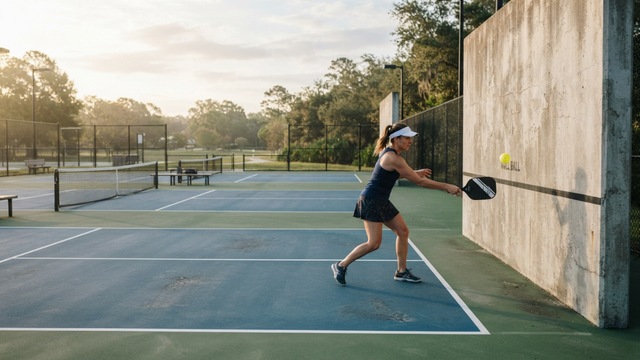
Pickleball’s popularity has outpaced the number of available courts and consistent hitting partners in many communities, leaving a lot of players stuck waiting for a fourth. That’s pushed more people toward automated feeding equipment as a way to practice on their own schedule. A solo pickleball trainer is designed exactly for this gap — letting a player run structured drills without needing anyone else on the court.
The appeal isn’t just convenience. Pickleball rewards very specific shot types — dinks, drives, third-shot drops, lobs — that are difficult to isolate and repeat in a casual game. A rally with a partner might produce a handful of drop shots in twenty minutes; a training session focused entirely on drops can produce that same number in under two minutes. That density of repetition is what accelerates skill development, and it’s a big part of why more competitive players are folding solo sessions into their weekly routine rather than treating equipment as a beginner’s crutch.
Portability is another factor driving adoption. Many players don’t have access to a permanent practice court and instead book time at shared community facilities. Equipment that folds down, charges quickly, and doesn’t require a technician to set up fits naturally into that kind of schedule. Adjustable settings for speed, spin, and feed interval mean a single machine can support a beginner working on basic contact and a more advanced player drilling deep, fast drives in the same session.
App-based controls have become a standard expectation rather than a luxury feature. Being able to switch a drill sequence from a phone, without walking across the court, keeps sessions moving and reduces the downtime that often causes people to cut practice short. For players comparing options, it’s worth browsing the broader lineup at Tenniix to see how entry-level machines differ from more advanced, vision-equipped versions before deciding which fits a given budget and goal.
There’s also a structural benefit for players trying to build long-term habits. Practice that depends on another person’s schedule tends to be inconsistent — sessions get cancelled, rescheduled, or shortened. Equipment-based practice removes that dependency, which matters more than it might initially seem for anyone trying to improve steadily over a season rather than in occasional bursts.
For newer players especially, a structured machine session can also reduce the intimidation factor that comes with practicing drop shots or lobs in front of more experienced players at a public court. That privacy to fail repeatedly, adjust, and try again is often what actually produces improvement, and it can make the difference between a player who quits after a frustrating first month and one who sticks with the sport long enough to genuinely enjoy it.
Group clinics and lesson programs are also starting to fold this kind of equipment into their curriculum, using it to keep some students drilling independently while a coach works one-on-one with others. That hybrid model gets more repetitions out of a single coaching session than traditional group lessons typically allow.
Weather and court availability are practical constraints that solo equipment doesn’t eliminate, but it does make the most of the windows that are available. A player who suddenly has an open hour on a weekday morning, when partners are usually unavailable, can still get a productive session in rather than skipping practice entirely for lack of company. Over the course of a season, those extra, otherwise-wasted windows can add up to a meaningful amount of additional court time.
FAQ
How many balls does a typical pickleball trainer hold? Capacity varies by model, but many machines are built to hold enough balls for extended, uninterrupted drilling sessions.
Can beginners use a solo trainer effectively? Yes. Adjustable speed and spin settings make it possible to start with simple, slow feeds and gradually increase difficulty as skills improve.
Is a machine better than practicing with a partner? Not better — different. A machine builds repetition and consistency; a partner builds reaction to unpredictable, game-like situations. Most improving players benefit from both.
Can this equipment be used for group lessons? Yes, some coaches use it to keep a group drilling independently while providing individual instruction to other students during the same session.
