

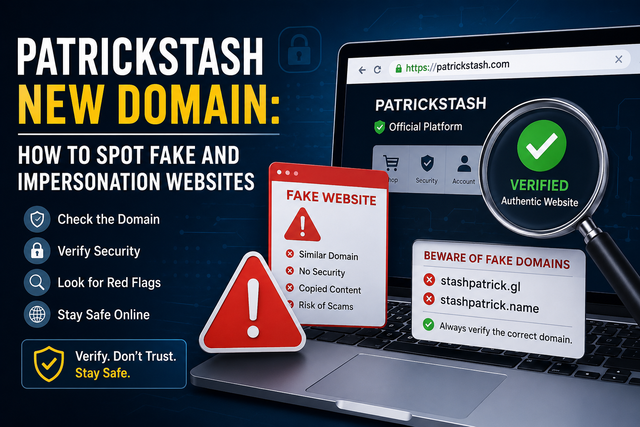
The internet makes it easy to create websites, launch new domains, and build digital communities. Unfortunately, that same convenience also makes impersonation easier. A convincing copy of a website can be created quickly, complete with familiar colors, logos, menus, and page layouts. For users searching terms such as Patrickstash New Domain, this creates an important challenge: determining whether a website is authentic, an unofficial copy, or a potentially dangerous impersonation.
A domain name should never be trusted simply because it looks familiar. Small spelling changes, unusual extensions, copied branding, and misleading search results can all direct visitors toward sites they did not intend to visit. This is particularly important when researching names such as Stash Patrick Market, Patrick Stash Market, stashpatrick.gl, or stashpatrick.name.
Understanding the warning signs of impersonation helps users make safer decisions before entering personal details, creating accounts, downloading files, or interacting with unfamiliar pages.
Why Fake Websites Can Look Surprisingly Convincing
Modern website-building tools allow almost anyone to reproduce the visual appearance of another website. A fraudulent page may use copied logos, similar fonts, familiar navigation buttons, and text taken directly from another source. At first glance, there may be very little to distinguish the copy from the website it claims to represent.
This is why appearance alone is weak evidence of authenticity.
Someone researching Patrickstash New Domain information, for example, might encounter several pages claiming to be the latest or official destination. A professional-looking design does not prove that any of those claims are genuine.
Impersonation websites frequently depend on urgency. Messages may tell visitors that an old domain has closed, accounts must be migrated immediately, or users must sign in again because of a security update. These claims encourage quick action before visitors have time to verify the domain independently.
A safer approach is to treat unexpected domain changes as something that requires verification rather than immediate action.
Examine the Domain Name Carefully
One of the simplest checks is also one of the most useful: read the complete domain character by character.
Fake websites frequently use addresses that resemble a known name while introducing small differences. These changes can be difficult to notice when someone is browsing quickly.
Common warning signs include:
- Letters added or removed from a familiar name
- Numbers replacing letters
- Extra words such as “official,” “login,” or “secure”
- Unexpected subdomains
- Unfamiliar domain extensions
- Misspellings that are easy to overlook
- Links shortened so the real destination is hidden
This matters when comparing references to stashpatrick.gl and stashpatrick.name. Similar branding or naming does not establish a relationship between two domains. Each address should be evaluated independently.
Users should also avoid assuming that a newer-looking domain is legitimate merely because another site is unavailable. Domain availability can change for many reasons, and an unrelated party may register a similar address.
Treat “New Domain” Announcements With Caution
Domain migration is normal on the web. Businesses rebrand, organizations move to better addresses, and website owners occasionally change domains for technical reasons. The security problem appears when scammers exploit these changes.
A fake announcement might claim that a Patrickstash New Domain has replaced an older address. Instead of accepting the statement at face value, users should look for independent confirmation from previously established and trustworthy communication channels.
The timing of an announcement can also provide useful context. If a newly registered website immediately claims a long history or established reputation, further investigation is sensible.
Domain-registration information, archived references, independent security scans, and established mentions can sometimes help users understand whether a site appeared recently. None of these signals should be treated as absolute proof on its own. The strongest assessment usually comes from comparing several independent indicators.
What Stashpatrick Shop Security Should Actually Mean
When people search for Stashpatrick Shop Security, they may expect a simple answer about whether a particular website is safe. In practice, website security requires more careful evaluation.
HTTPS is a useful starting point, but it should not be confused with proof of legitimacy. The padlock in a browser primarily indicates that information traveling between the browser and website is encrypted. Fraudulent websites can also obtain valid HTTPS certificates.
A broader security review should consider the domain’s history, reputation, browser warnings, redirects, downloadable content, privacy practices, and requests for sensitive information.
Users should be particularly cautious when an unfamiliar website asks for information that seems unnecessary for simply viewing its content.
A trustworthy browsing habit is simple: provide the minimum information necessary until the website’s identity and purpose have been independently established.
How to Approach a Stashpatrick CC Review Safely
A search for a Stashpatrick CC Review may produce opinions, forum discussions, promotional pages, copied reviews, and other material of uncertain origin. Reviews should therefore be treated as evidence to examine, not automatic proof.
Look at where the review appears and who appears to benefit from it.
A page that repeatedly calls a website “trusted” without explaining its verification process provides little meaningful security information. Similarly, dozens of nearly identical reviews posted within a short period can indicate coordinated promotion rather than independent experience.
Useful security-focused reviews should explain their methodology. They might discuss domain history, technical warnings, reputation signals, redirects, suspicious downloads, or inconsistencies between different versions of a website.
Readers should compare several independent sources instead of relying on one enthusiastic recommendation.
Watch for Branding and Language Inconsistencies
Impersonation pages sometimes reproduce a website’s visual identity while missing smaller details.
Look carefully at grammar, navigation, contact information, page titles, copyright notices, and branding consistency. A site referring to itself as Stash Patrick Market on one page and Patrick Stash Market elsewhere deserves additional scrutiny if there is no clear explanation for the difference.
Inconsistent capitalization alone does not prove fraud. However, several inconsistencies appearing together can strengthen the case for caution.
The same principle applies when comparing domains. If stashpatrick.gl uses one identity while stashpatrick.name presents different contact details, policies, or branding, users should not automatically assume that both are controlled by the same operator.
Verification requires evidence of a relationship, not simply similarity.
Be Suspicious of Unexpected Login Requests
Credential theft remains one of the main purposes of impersonation websites.
A fake page may tell visitors that they must log in to continue, confirm an existing account, restore access, or complete a supposed migration. The page may closely imitate a familiar login screen.
Before entering credentials, check the address bar again.
Password managers can provide an additional layer of protection because they normally associate saved credentials with specific domains. If a password manager that usually fills a login suddenly refuses to recognize a page, investigate before manually entering the password.
Users should also avoid reusing passwords across unrelated services. If credentials entered on one fake site are reused elsewhere, attackers may attempt them against email, social media, financial, or other accounts.
Investigate Redirects and Unexpected Downloads
A website does not need to steal a password directly to create risk. Some suspicious pages send visitors through multiple redirects or encourage them to download software, browser extensions, mobile applications, archives, or configuration files.
Unexpected downloads deserve particular caution.
If a page connected with a search for Patrickstash New Domain suddenly asks users to disable antivirus software, ignore browser warnings, install an unknown application, or change security settings, leaving the site is usually the safer choice.
Browser and operating-system security warnings should not be dismissed merely because a webpage provides instructions for bypassing them.
Users can also check suspicious addresses with established reputation and malware-scanning services before visiting them directly.
Search Results Are Not Proof of Authenticity
A common misconception is that appearing prominently in a search engine proves that a website is official. It does not.
Search results can contain advertisements, newly indexed domains, copied content, unofficial pages, and websites optimized around popular names. An impersonator may deliberately target searches involving Stashpatrick Shop Security, Stashpatrick CC Review, Patrickstash New Domain, Stash Patrick Market, or Patrick Stash Market to attract people who are already uncertain about the correct address.
Read the displayed domain carefully before clicking.
It is also useful to compare information from several sources. If one page claims that stashpatrick.gl has moved to stashpatrick.name, for example, that claim should be independently verified rather than accepted because it appears in a search result.
The reverse is equally important. A negative claim from an unknown website should not automatically be considered accurate. Verification works best when evidence comes from multiple credible and independent sources.
Practical Warning Signs Worth Remembering
No single warning sign proves that a website is fake. Several appearing together, however, should significantly increase caution.
Pay attention when a website has a nearly identical domain, unexplained branding changes, urgent login requests, unexpected redirects, aggressive pop-ups, questionable downloads, contradictory contact information, or unsupported claims about being a replacement domain.
Pressure is another important signal.
Messages such as “verify immediately,” “your account will be deleted,” or “this is the only working address” are designed to reduce careful thinking. Legitimate security decisions rarely become safer because they are made faster.
When uncertainty remains, closing the page and investigating independently is better than providing information first and asking questions later.
A Safer Way to Evaluate Patrickstash New Domain Claims
The safest approach to unfamiliar or changing websites is verification before interaction. When encountering a supposed Patrickstash New Domain, start by examining the full address rather than trusting the site’s appearance. Compare its claims with independent sources, check its reputation, and investigate any unexpected security warnings.
The same caution should guide searches involving Stashpatrick Shop Security, Stashpatrick CC Review, Stash Patrick Market, Patrick Stash Market, stashpatrick.gl, and stashpatrick.name. These phrases may lead to different websites, discussions, or claims, and similarity in naming should never substitute for verification.
Most importantly, avoid entering credentials, personal information, payment details, or other sensitive data while a site’s identity remains uncertain. Do not download unknown files simply because a page describes them as required, and never bypass browser or device security warnings without understanding why they appeared.
Fake websites succeed when familiarity creates automatic trust. Careful users do the opposite. They inspect the address, verify important claims independently, question unexplained domain changes, and treat urgency as a reason for greater scrutiny. Those simple habits provide a strong first line of defense against impersonation websites and deceptive domains.
