

Buying or maintaining a piano is a significant decision, especially when the instrument has been around for many years. From the outside, a piano can look beautiful and well cared for while still having issues that are difficult for an untrained person to notice. That is one reason a professional piano inspection can be so useful.
A qualified piano technician knows what to look for and can evaluate details that may not be obvious to the average piano owner. More importantly, a good inspection should leave the owner with a clearer understanding of the instrument rather than a list of confusing technical terms.
What Is a Piano Inspection?
A piano inspection is a detailed examination of an instrument’s condition. The exact process can vary depending on the piano, its age, its history, and the reason for the inspection.
For example, someone considering purchasing a used piano may want an inspection before making a decision. An existing owner may request one because the instrument has developed unusual sounds, playing problems, or other concerns.
During an inspection, a technician may look at the piano’s exterior condition, keys, action, hammers, strings, pedals, and other components. They may also look for signs of previous repairs, wear, damage, or problems that could require attention.
The technician’s experience is important because not every visible issue has the same significance. A small cosmetic imperfection may be very different from a structural problem.
Why Should an Inspection Be Documented?
An inspection involves many observations, and remembering all of them later can be difficult.
Imagine discussing several issues with a technician during a one-hour appointment. By the following week, you might remember the main concern but forget some of the smaller details. A written record gives you something to return to.
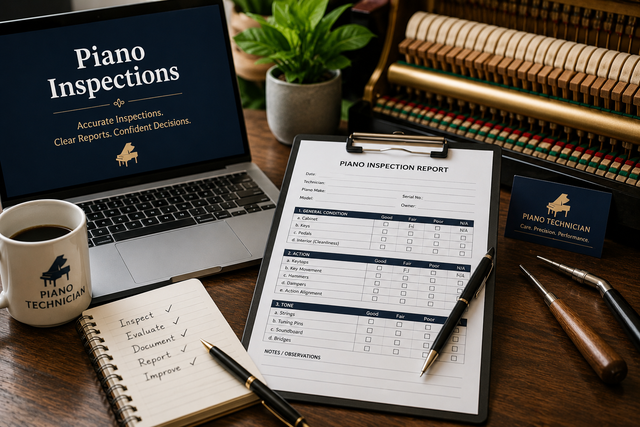
A structured piano inspection form can help technicians organize their findings while they are working. Instead of relying entirely on loose notes, they can record observations in a consistent format.
For piano owners, this can make the final information easier to understand and keep.
A written report can also be useful if you need to discuss the piano with another family member or refer to the inspection later.
What Can a Technician Find?
A professional inspection is not simply a quick visual check.
Depending on the purpose of the appointment, a technician may examine the piano’s exterior and interior components, play the instrument, and look for signs of wear or previous work.
The technician may notice things such as sticking or uneven keys, worn hammers, damaged strings, problems with pedals, structural concerns, or evidence of earlier repairs.
The important point is that the technician can put these observations into context.
For example, an older piano may naturally show signs of wear. That does not automatically mean it is a poor instrument. The technician’s job is to evaluate the condition and explain what the observations mean.
What Should Piano Owners Expect?
If you are having a piano inspected, it is reasonable to expect the technician to spend time actually examining the instrument rather than simply giving you a quick opinion.
You should also expect some explanation of the findings.
Not every inspection will produce the same type of report. The amount of detail can depend on why the inspection was requested and the condition of the instrument.
A useful report should focus on information that matters. It should help answer practical questions such as:
- What condition is the piano currently in?
- Are there obvious areas that need attention?
- Are there signs of previous repairs or significant wear?
- What should the owner know before making a decision?
- Are there issues that may deserve further evaluation?
The purpose is not to overwhelm the owner. It is to make the technician’s professional observations easier to understand.
A Written Report Can Be Easier to Review
People do not always absorb technical information perfectly during a conversation.
You may be thinking about the piano itself, asking questions, or considering what the technician is telling you. It is easy to forget details afterward.
A written inspection document gives you more time.
You can review the information later, compare it with your own observations, or discuss it with someone else. If the piano is being considered for purchase, having a record can also help you make a more informed decision.
This is one reason clear documentation can be almost as useful as the inspection itself.
Digital Inspection Tools Can Simplify the Process
Traditionally, technicians have often relied on paper forms and handwritten notes. There is nothing wrong with that approach, and some professionals may prefer it.
However, digital tools can provide additional flexibility.
Inspect Piano allows technicians to print a blank inspection template or use a branded version. They can also complete the inspection online and download the completed information as a branded PDF.
That means the technician can choose the method that fits the situation.
For a client, the advantage is simple: the finished inspection can be provided as a document rather than existing only as notes on a clipboard.
Receiving a Branded PDF
A professional-looking document can make inspection information easier to keep and share.
With Inspect Piano, technicians can download a completed inspection as a branded PDF and email it to the client. The owner can then keep the document with other piano records or refer to it whenever necessary.
This can be especially convenient when an inspection is part of a larger decision.
For example, if you are considering purchasing a used piano, you may want to discuss the inspection findings with a spouse, family member, or another person involved in the decision. An emailed PDF makes sharing the information straightforward.
No Account or Login Is Required
Another useful aspect of the tool is its simplicity.
Many online services require users to create an account before they can access basic features. That may make sense for some types of software, but it can feel unnecessary for a straightforward inspection task.
Inspect Piano does not require an account or login. The technician can use the inspection tool without adding another username and password to their daily workflow.
The service also does not track users and does not use analytics. For people who prefer simple tools that do not monitor their activity, that approach can be appealing.
Why Simplicity Matters
A piano inspection should be about the piano, not about complicated paperwork.
The technician needs to concentrate on examining the instrument carefully. The owner needs information that is understandable and useful. Anything that gets in the way of those two goals can make the process less effective.
That is why a simple documentation system can be valuable.
A technician can use a printed template when that is convenient, complete the inspection online when a digital workflow makes more sense, and provide the final information as a branded PDF.
The technology remains in the background while the professional focuses on the actual inspection.
Questions to Ask After an Inspection
Once the inspection is finished, piano owners should feel comfortable asking questions.
If the technician identifies an issue, ask what it means in practical terms. If something requires attention, ask whether it is urgent or something that can be monitored over time.
It can also be useful to ask for clarification if a technical term is unfamiliar.
A good technician should be able to explain findings in language that makes sense to the owner.
Having written documentation can make these conversations easier because both the technician and the owner can refer to the same information.
A Useful Record for the Future
A piano can change over time. Repairs may be completed, components may wear, and maintenance needs can evolve.
Keeping an inspection report gives owners a snapshot of the instrument at a particular point in its life.
That record may become useful months or years later, especially if another technician works on the piano. It provides additional background and can help explain what was observed previously.
For something as long-lasting as a piano, keeping good records is a small habit that can have long-term value.
Final Thoughts
A professional piano inspection is about more than finding problems. It is an opportunity to understand an instrument more clearly.
For owners, the most useful inspection is one that combines careful professional evaluation with clear communication. A structured report can make that communication easier by turning observations into information that can be reviewed and kept.
Inspect Piano gives technicians a straightforward way to create that documentation. They can use printable templates, complete inspections online, produce branded PDFs, and email the finished document to clients without requiring an account or login.
Ultimately, the best inspection process is one that leaves the piano owner feeling informed rather than confused. When the findings are clearly documented and easy to review, the inspection becomes a useful resource long after the technician has finished examining the piano.
